Why Distributed QA Teams Are Critical for Continuous Delivery
Continuous delivery is often described as a technical discipline.
Teams talk about pipelines, automation, deployment strategies, feature flags, monitoring, and rollback plans.
All of those matter.
But there is another part of continuous delivery that receives less attention:
Can the organization validate change fast enough to keep up with the speed of development?
For many growing technology companies, the answer is no.
The engineering team can build faster than the organization can confidently release.
That is where distributed QA teams become critical.
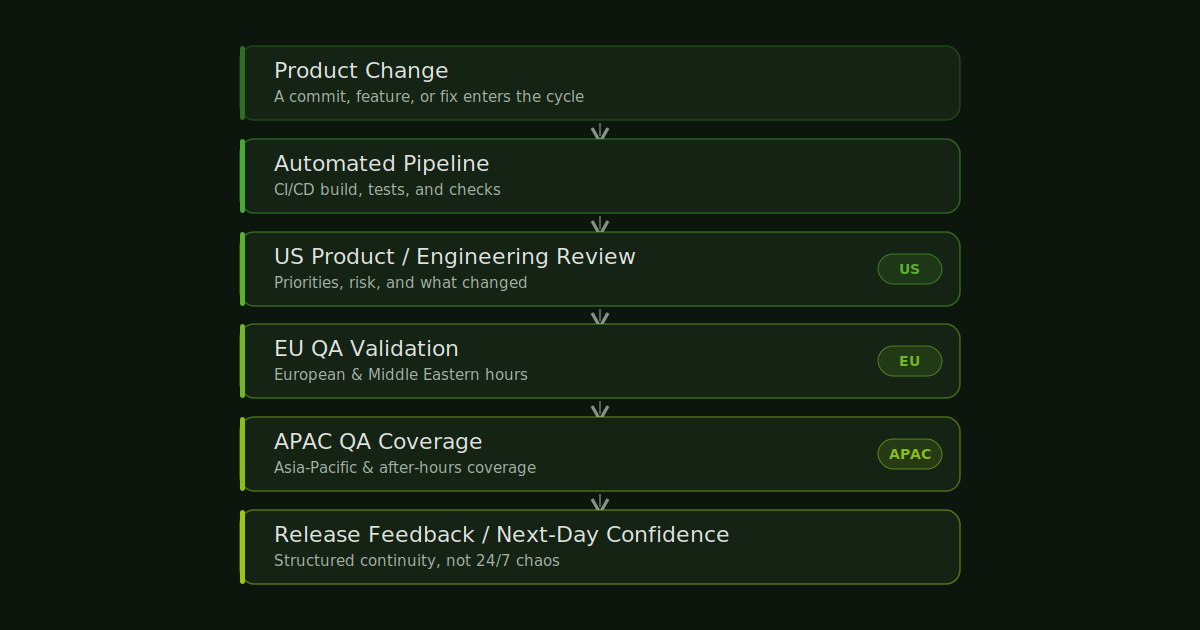
Distributed QA extends the validation window, helping teams maintain release confidence across time zones.
Continuous Delivery Is Not Only a DevOps Problem
A company can have excellent CI/CD infrastructure and still struggle to release with confidence.
Why?
Because automation does not eliminate the need for judgment.
Modern software products contain:
- Complex user workflows
- Integrations
- Permissions
- Mobile and web experiences
- Customer-specific configurations
- Regional behavior
- Data quality issues
- AI-assisted features
- Edge cases that automation may not detect
Automated tests are essential, but they do not cover every risk.
Continuous delivery requires a combination of automation, human validation, product knowledge, and operational discipline.
The Bottleneck Moves From Deployment to Validation
As engineering teams mature, deployment becomes easier.
The bottleneck shifts.
Instead of asking:
Can we deploy?
The company starts asking:
Are we confident this release is safe?
That question is harder.
It requires understanding:
- What changed
- What workflows are affected
- Which customers may be impacted
- Which parts of the product are fragile
- Which tests must be repeated
- Which issues are acceptable
- Which issues block the release
This is where QA becomes an operational function rather than a final checklist.
Why Local-Only QA Becomes a Constraint
When QA is concentrated in one location or time zone, release cycles become dependent on local availability.
This creates problems:
- Late-day changes wait until the next morning.
- Urgent validation is delayed.
- Releases depend on a small number of people.
- International teams lose momentum.
- Product teams operate faster than QA can respond.
For companies with customers across regions, this gap becomes more visible.
A distributed QA model helps reduce that constraint.
Distributed QA Extends the Testing Window
A well-structured distributed QA team allows validation to continue across time zones.
For example:
- EU-based QA can support European and Middle Eastern business hours.
- APAC-based QA can support Asia-Pacific and after-hours North American coverage.
- US-based coordination can align priorities, communication, and client expectations.
This does not mean teams should work chaotically around the clock.
It means the company can design a broader operational window for validation and support.
The result is not only more hours.
The result is more continuity.
Around-the-Clock Does Not Mean Always-On Chaos
Some companies hear "global coverage" and imagine a messy 24/7 operation.
That is not the goal.
The goal is structured continuity.
A good distributed QA model defines:
- What gets tested in each region
- How handoffs happen
- What must be escalated
- What can wait
- Where test results are documented
- Who owns release decisions
- Which workflows are highest priority
Without structure, distributed teams create confusion.
With structure, they create velocity.
Distributed QA Helps Protect Engineering Focus
When QA coverage is weak, engineers absorb the burden.
They spend more time:
- Reproducing bugs
- Manually checking workflows
- Supporting releases
- Investigating customer reports
- Re-validating fixes
- Handling preventable issues
This slows down product development.
A strong QA operation protects engineering focus by making validation more systematic.
Engineers still own quality.
But they are not forced to be the only line of defense.
Continuous Delivery Requires Regression Discipline
One of the biggest risks in fast-moving products is regression.
A team fixes one issue and accidentally breaks another workflow.
This is especially common in:
- SaaS platforms with many customer paths
- AI products with evolving workflows
- Fintech platforms with compliance-sensitive flows
- Products with multiple roles and permissions
- Systems with complex integrations
Distributed QA teams can help maintain regression discipline by executing structured test coverage across releases.
This is not glamorous work.
But it is essential.
AI and Computer Vision Products Increase the Need for Human Validation
AI changes the QA problem.
Traditional software usually has deterministic behavior. A workflow either works or does not.
AI-powered systems often require a different kind of validation.
Teams may need to evaluate:
- Output quality
- Edge cases
- Visual interpretation
- Human-in-the-loop workflows
- Data inconsistencies
- Model behavior under unusual conditions
- Operational reliability in real-world usage
Automation helps, but human review remains essential.
For AI and computer vision platforms, distributed QA can provide the human validation layer needed to support continuous delivery without slowing the product team down.
The Best Distributed QA Teams Build Product Memory
Continuous delivery becomes safer when QA teams develop long-term product knowledge.
They learn:
- Which features are risky
- Which customers use the product in unusual ways
- Which bugs tend to return
- Which workflows need special attention
- Which releases require deeper validation
This product memory compounds over time.
That is why stable, long-term QA teams are more valuable than temporary testing capacity.
What a Strong Model Looks Like
A strong distributed QA model usually includes:
- Embedded QA professionals
- Clear product ownership
- Regional coverage
- Defined handoff process
- Release checklists
- Regression plans
- Bug quality standards
- QA leads or coordinators
- Regular reporting
- Continuous improvement
The goal is not just to test more.
The goal is to make quality assurance predictable.
Continuous Delivery Needs Operational Confidence
The real promise of continuous delivery is not deploying more often.
It is delivering value safely, repeatedly, and confidently.
That confidence does not come from tools alone.
It comes from:
- Automation
- Engineering discipline
- Product knowledge
- QA operations
- Clear communication
- Reliable coverage
Distributed QA teams help connect those pieces.
Final Thought
Continuous delivery is a company capability, not just a technical pipeline.
As products grow, quality assurance must grow with them.
For AI, SaaS, fintech, and other complex technology platforms, distributed QA operations can become one of the most practical ways to maintain release confidence while continuing to move fast.
The companies that scale well are not the ones that eliminate QA.
They are the ones that make QA part of the operating system.
Need QA Coverage That Keeps Up With Your Release Cycle?
Oliant helps AI and SaaS companies build distributed QA operations through coordinated teams across the United States, Europe, and APAC.