How to Integrate External QA Teams Without Losing Control
Growing technology companies eventually reach a point where quality assurance becomes too important to handle casually.
At first, testing is informal. Engineers test their own work. Product managers check the flows they care about. Founders personally review critical releases. This works while the product is small and the team is compact.
But as the company grows, the product becomes more complex. More customers depend on it. More edge cases appear. More releases happen in parallel. Suddenly, QA is no longer a task. It becomes an operational function.
That is often the moment when companies consider external QA support.
The concern is understandable:
How do we add external QA capacity without losing control?
The answer is not simply to hire testers. The answer is to design an operating model.
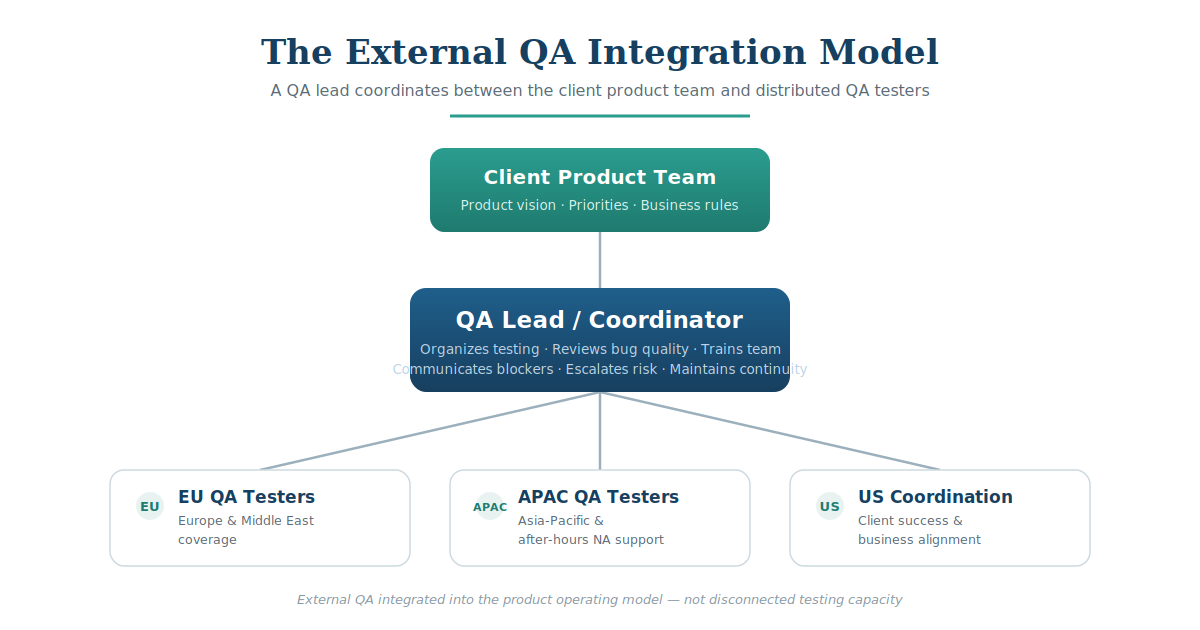
External QA works best when it is integrated into the product operating model, not treated as disconnected testing capacity.
The Problem With Treating QA as Extra Hands
Many companies approach QA augmentation as a capacity problem.
They think:
We need more people to test.
That may be true, but it is incomplete.
If external QA professionals are added without structure, several problems appear quickly:
- They do not understand the product deeply enough.
- They depend too heavily on internal engineers.
- They test tickets but do not understand business risk.
- They miss context from product discussions.
- They become reactive instead of operational.
- The internal team spends too much time explaining instead of shipping.
This is why many outsourced QA arrangements disappoint.
The issue is rarely the individual tester. The issue is the lack of an integration model.
External QA Should Be Embedded, Not Detached
The best QA teams are not isolated from engineering. They are embedded into the way the company builds, releases, and supports software.
That means external QA should participate in the rhythm of the team.
At minimum, they need visibility into:
- Product priorities
- Release schedules
- Bug history
- Known fragile areas
- Customer-impacting workflows
- Regression risks
- Support issues
- Acceptance criteria
Without that context, QA becomes mechanical.
With that context, QA becomes operational.
Start With the Product Areas That Matter Most
The first mistake companies make is trying to test everything equally.
Not every workflow has the same business impact.
A strong QA integration begins by identifying the areas where failure matters most.
For a SaaS platform, that may include:
- Login and authentication
- Billing
- Core user workflows
- Admin permissions
- Data import/export
- Reporting
- Integrations
- Mobile flows
- Customer-facing dashboards
For an AI or computer vision platform, it may include:
- Data quality
- Visual validation
- Model output review
- Human-in-the-loop workflows
- Edge cases
- Field conditions
- Workflow consistency
External QA teams should be trained first on the areas where quality risk is highest.
Define Ownership Clearly
External QA fails when nobody knows who owns what.
A healthy model defines ownership across four levels.
1. Product Ownership
The client owns the product vision, priorities, and business rules.
2. Engineering Ownership
The engineering team owns implementation, technical architecture, and fixes.
3. QA Ownership
The QA team owns test coverage, validation, regression execution, defect reporting, and quality feedback.
4. Operational Ownership
The partner managing the QA team owns staffing, continuity, training, coverage, reporting, and process improvement.
This distinction matters.
If QA ownership is unclear, the team becomes passive. If operational ownership is missing, the client ends up managing individuals instead of outcomes.
Use QA Leads, Not Just QA Resources
A common mistake is to add several QA people without a lead.
This creates coordination overhead for the client.
A better model is to establish a QA lead or coordinator who can:
- Understand client priorities
- Organize testing activities
- Review bug quality
- Train new QA team members
- Communicate blockers
- Escalate risks
- Maintain continuity
This is one of the key differences between simple staff augmentation and managed QA operations.
With staff augmentation, the client manages the people.
With managed QA operations, the partner manages the function.
Build a Shared Testing Language
External QA teams need more than access to Jira, Linear, Azure DevOps, or another ticketing tool.
They need a shared language with the internal team.
That includes agreed definitions for:
- Critical bugs
- Major bugs
- Minor bugs
- Regression issues
- Release blockers
- Expected behavior
- Known limitations
- Not reproducible issues
- Acceptance criteria
Without this shared language, QA reports become noisy.
With it, QA reports become useful.
Document the Product as Testing Evolves
Documentation should not be a separate theoretical effort.
It should grow naturally from QA activity.
Every recurring workflow should eventually produce:
- Test scenarios
- Regression checklists
- Known edge cases
- Product notes
- Environment setup instructions
- Common issue patterns
This creates compounding value.
The external QA team becomes more effective over time because product knowledge accumulates instead of disappearing when people change roles.
Communication Cadence Matters
The most successful external QA relationships are not built around constant meetings.
They are built around predictable communication.
A practical cadence may include:
- Daily async updates
- Weekly QA summary
- Release-specific test reports
- Escalation process for blockers
- Monthly process review
The goal is not to create bureaucracy.
The goal is to make quality visible.
Global Teams Need Regional Structure
If QA is distributed across regions, the model needs even more clarity.
For example, a company may use:
- EU-based QA for European and Middle Eastern coverage
- APAC-based QA for Asia-Pacific and after-hours North American support
- US-based coordination for client success and business alignment
This type of model can provide broader coverage without forcing the client to build a large internal QA department.
But it only works when handoffs, responsibilities, and reporting are clear.
The Best External QA Teams Become Part of the Product Memory
A strong QA team does more than execute test cases.
Over time, it develops product memory.
It knows:
- Which areas break often
- Which customer workflows are sensitive
- Which releases are risky
- Which bugs are likely to reappear
- Which edge cases matter
- Which parts of the product need extra attention
This memory is valuable.
It is also one of the main reasons long-term QA partnerships outperform short-term testing projects.
How to Know the Integration Is Working
External QA is working when:
- Engineers trust the bug reports.
- Product managers trust the release feedback.
- QA can operate without constant explanation.
- The team identifies risks earlier.
- Regression coverage improves.
- Release confidence increases.
- The client spends less time managing people and more time making decisions.
The goal is not simply to add testing capacity.
The goal is to increase operational confidence.
Final Thought
External QA should not feel like a disconnected vendor activity.
It should feel like an extension of the product organization.
That requires more than hiring testers. It requires structure, ownership, communication, product knowledge, and long-term continuity.
For growing AI and SaaS companies, this is where distributed QA operations become powerful.
The right external QA model does not remove control from the internal team.
It gives the internal team more control by making quality visible, structured, and scalable.
Need to Scale QA Without Losing Control?
Oliant helps AI and SaaS companies build distributed QA operations through coordinated teams across the United States, Europe, and APAC.